

- 网站导航 -
Address:HOME > Products > Spring Brake Chamber >
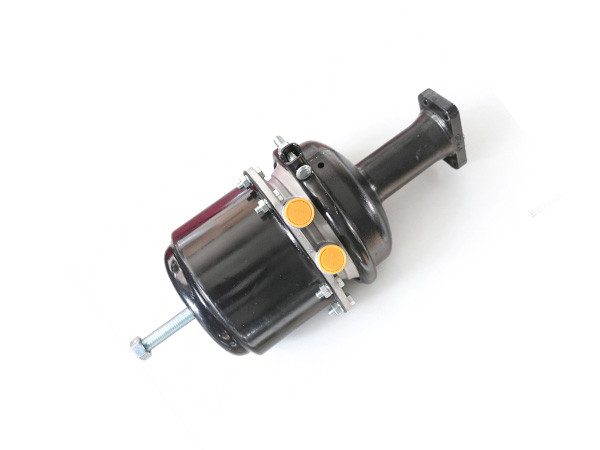
Flange type vertical dual‑chamber spring brake chamber
E-mail: tusheng965@gmail.com
Tel:8615932726000
Flange type vertical dual‑chamber spring brake chamber Overview
The Flange type vertical dual‑chamber spring brake chamber is an air-brake actuator used on commercial vehicles, trucks, buses and trailers to convert compressed air pressure into linear braking force. It combines a service brake chamber for normal foot-brake operation with a spring brake section that holds the parking brake and acts as an emergency brake when air pressure drops. It is supplied as a replacement air-brake component for workshops, fleet maintenance teams and aftermarket distributors needing a dependable chamber matching the original chamber type, mounting and diaphragm specifications.
Every Flange type vertical dual‑chamber spring brake chamber consists of a service diaphragm chamber, a spring chamber with a powerful coil spring, push rod, clevis or mounting bracket and air connection ports. The service chamber applies the brakes when the driver presses the brake pedal; the spring chamber applies the parking brake mechanically when air is exhausted and releases it when system pressure rebuilds. The unit is assembled and tested for air tightness and push-rod travel before packing.
What Is a Spring Brake Chamber
A spring brake chamber is a dual-function actuator found on air-brake systems. The service half uses compressed air to push the diaphragm and push rod against the brake slack adjuster during normal braking. The spring half stores energy in a large compressed spring that applies the parking or emergency brake when air pressure is released; supplying air to the spring chamber compresses the spring and releases the brake. Chamber size codes such as T20, T24 and T30 describe the diaphragm and push-rod displacement, and mounting may be bolt-type, flange-type or vertical dual-chamber.
Key Features and Construction
The Flange type vertical dual‑chamber spring brake chamber uses reinforced rubber diaphragms, a steel or aluminium housing, a tempered coil spring, push rod and clevis connection. The diaphragms seal the air chambers and transfer pressure to the push rod, while the spring supplies the parking brake force without relying on stored air. Ports for the service and spring circuits are positioned to match the vehicle's air-brake plumbing.
The housing is built to resist corrosion and withstand repeated pressure cycles, and the push rod is finished for smooth movement in its guide. Bolt-type and flange-type mounts match different brake and axle layouts, while dual-chamber designs combine service and spring functions in one compact unit. Diaphragm material is chosen for flexibility, heat resistance and long life under repeated braking, and fasteners and seals are checked for fit before the unit leaves production.
Specifications and Applications
The Flange type vertical dual‑chamber spring brake chamber is classified by chamber size, diaphragm type, mounting style and port arrangement. Size code, push-rod length, clevis type, bolt pattern or flange dimension vary by axle and vehicle model, so the exact specification should be matched against the original part before purchase. Buyers should confirm the brake system type, chamber pairing and mounting configuration on the vehicle.
Chambers of this type are fitted to heavy trucks, tractors, dump trucks, buses, trailers and commercial vehicles using air-over-hydraulic or full air-brake systems. They are supplied as individual replacement chambers or in matched pairs for an axle. Because chamber sizes and mounting styles differ between drum brakes and disc brakes, and between left and right axle fitments, the unit should be cross-checked against the original part number and vehicle details.
Performance Benefits and Quality Control
A properly matched Flange type vertical dual‑chamber spring brake chamber delivers consistent service braking and reliable spring-applied parking braking. A sound diaphragm and sealing assembly prevent air leakage, while a free-moving push rod and correct slack-adjuster stroke keep braking force balanced across the axle. The stored spring force holds the vehicle securely when parked and provides emergency braking if main air pressure is lost.
Each chamber is inspected for housing dimensions, diaphragm fit, spring condition, push-rod movement and air tightness before leaving the line. Ports, seals and mounting points are checked against the drawing, and the unit is pressure-tested for leaks. Finished chambers are packed to protect the diaphragm, push rod and spring assembly during storage and transport.
Installation and Maintenance
When fitting the Flange type vertical dual‑chamber spring brake chamber, inspect the brake slack adjuster, push-rod stroke and diaphragm condition, and replace seals or diaphragms that show cracks, hardening or leakage. Match the chamber size and mounting to the original unit, connect the service and spring air lines to the correct ports, and check the clevis pin and retainer for wear. Always follow safe procedures when handling a spring chamber: the compressed spring holds strong force, so spring cages or proper service methods should be used before disassembly.
Maintain correct air pressure in the reservoir system and keep drains clear of moisture. Check push-rod travel and brake balance during scheduled service, and listen for air leaks at the chamber ports and diaphragm. If braking feels weak, the parking brake does not hold, or air pressure drops quickly, inspect the diaphragms, seals, spring chamber and air lines promptly.
Frequently Asked Questions
What do chamber size codes mean? Codes such as T20, T24/30DP and T30/30DD indicate the diaphragm diameter and chamber combination, which determine push-rod force and stroke. The code must match the original chamber on the axle.
How does the parking brake work in a spring chamber? The spring section holds a compressed coil spring that applies the brake when air is exhausted. Air pressure is used to compress the spring and release the parking brake, so a spring chamber can hold the vehicle even if main air pressure falls.
Can I replace just one chamber? One chamber can be replaced if its mate is in good condition, but matching chamber size and stroke on both sides of an axle helps keep braking balanced. Replace diaphragms or seals at the first sign of leakage.






Contact
E-mail:tusheng965@gmail.com
whatsApp:8613012022227
Tel:8615932726000
URL:https://www.tushengautoparts.com
Address:No. 072, 1st Street, Auto Parts Market, Migezhuang Village, Migezhuang Town, Hejian City, Cangzhou City, Hebei Province